On Thinking
How we decide, persuade, and understand
On Thinking
Annie Duke
Annie Duke
“A big favorite among investors these days.”—The New York Times
“Outstanding.”—Jason Zweig, The Wall Street Journal
In Super Bowl XLIX, Seahawks coach Pete Carroll made one of the most controversial calls in football history: With 26 seconds remaining, and trailing by four at the Patriots' one-yard line, he called for a pass instead of a hand off to his star running back. The pass was intercepted and the Seahawks lost. Critics called it the dumbest play in history. But was the call really that bad? Or did Carroll actually make a great move that was ruined by bad luck?
Even the best decision doesn't yield the best outcome every time. There's always an element of luck that you can't control, and there is always information that is hidden from view. So the key to long-term success (and avoiding worrying yourself to death) is to think in bets: How sure am I? What are the possible ways things could turn out? What decision has the highest odds of success? Did I land in the unlucky 10% on the strategy that works 90% of the time? Or is my success attributable to dumb luck rather than great decision making?
Annie Duke, a former World Series of Poker champion turned business consultant, draws on examples from business, sports, politics, and (of course) poker to share tools anyone can use to embrace uncertainty and make better decisions. For most people, it's difficult to say "I'm not sure" in a world that values and, even, rewards the appearance of certainty. But professional poker players are comfortable with the fact that great decisions don't always lead to great outcomes and bad decisions don't always lead to bad outcomes.
By shifting your thinking from a need for certainty to a goal of accurately assessing what you know and what you don't, you'll be less vulnerable to reactive emotions, knee-jerk biases, and destructive habits in your decision making. You'll become more confident, calm, compassionate and successful in the long run.

"Dalam berbagai situasi, kita sering kali dihadapkan dengan pilihan sulit: bertahan, berubah arah, atau bahkan berhenti (quit). Nyatanya, walau banyak pertanda tak ada guna untuk tetap bertahan, berhenti identik dengan kata gagal, sehingga tak pernah jadi pilihan.
Annie Duke menawarkan strategi berbasis sains yang dapat mengasah keterampilan untuk mengetahui kapan kita harus memilih berhenti dan bagaimana cara melakukannya. Saat Anda sedang menghadapi permasalahan bisnis, karier, atau bahkan hubungan pribadi, piawai dalam memilih mana hal yang harus dipertahankan atau tidak dapat membantu Anda untuk menentukan langkah terbaik berikutnya.
Hidup ini singkat. Tak sepatutnya kita membuang waktu, energi, atau uang karena terus mempertahankan keputusan yang salah."
What do you do when you're faced with a big decision? If you're like most people, you probably make a pro and con list, spend a lot of time obsessing about decisions that didn't work out, get caught in analysis paralysis, endlessly seek other people's opinions to find just that little bit of extra information that might make you sure, and finally go with your gut.
What if there was a better way to make quality decisions so you can think clearly, feel more confident, second-guess yourself less, and ultimately be more decisive and be more productive?
Making good decisions doesn't have to be a series of endless guesswork. Rather, it's a teachable skill that anyone can sharpen. In How to Decide, bestselling author Annie Duke and former professional poker player lays out a series of tools anyone can use to make better decisions. You'll learn:
- To identify and dismantle hidden biases.
- To extract the highest quality feedback from those whose advice you seek.
- To more accurately identify the influence of luck in the outcome of your decisions.
- When to decide fast, when to decide slow, and when to decide in advance.
- To make decisions that more effectively help you to realize your goals and live your values.
Through interactive exercises and engaging thought experiments, this book helps you analyze key decisions you've made in the past and troubleshoot those you're making in the future. Whether you're picking investments, evaluating a job offer, or trying to figure out your romantic life, How to Decide is the key to happier outcomes and fewer regrets.
Taleb
Taleb
Fooled by Randomness is the word-of-mouth sensation that will change the way you think about business and the world. Nassim Nicholas Taleb–veteran trader, renowned risk expert, polymathic scholar, erudite raconteur, and New York Times bestselling author of The Black Swan–has written a modern classic that turns on its head what we believe about luck and skill.
This book is about luck–or more precisely, about how we perceive and deal with luck in life and business. Set against the backdrop of the most conspicuous forum in which luck is mistaken for skill–the world of trading–Fooled by Randomness provides captivating insight into one of the least understood factors in all our lives. Writing in an entertaining narrative style, the author tackles major intellectual issues related to the underestimation of the influence of happenstance on our lives.
The book is populated with an array of characters, some of whom have grasped, in their own way, the significance of chance: the baseball legend Yogi Berra; the philosopher of knowledge Karl Popper; the ancient world’s wisest man, Solon; the modern financier George Soros; and the Greek voyager Odysseus. We also meet the fictional Nero, who seems to understand the role of randomness in his professional life but falls victim to his own superstitious foolishness.
However, the most recognizable character of all remains unnamed–the lucky fool who happens to be in the right place at the right time–he embodies the “survival of the least fit.” Such individuals attract devoted followers who believe in their guru’s insights and methods. But no one can replicate what is obtained by chance.
Are we capable of distinguishing the fortunate charlatan from the genuine visionary? Must we always try to uncover nonexistent messages in random events? It may be impossible to guard ourselves against the vagaries of the goddess Fortuna, but after reading Fooled by Randomness we can be a little better prepared.
Named by Fortune One of the Smartest Books of All Time
A Financial Times Best Business Book of the Year
In his most provocative and practical book yet, one of the foremost thinkers of our time redefines what it means to understand the world, succeed in a profession, contribute to a fair and just society, detect nonsense, and influence others. Citing examples ranging from Hammurabi to Seneca, Antaeus the Giant to Donald Trump, Nassim Nicholas Taleb shows how the willingness to accept one’s own risks is an essential attribute of heroes, saints, and flourishing people in all walks of life.
As always both accessible and iconoclastic, Taleb challenges long-held beliefs about the values of those who spearhead military interventions, make financial investments, and propagate religious faiths. Among his insights:
• For social justice, focus on symmetry and risk sharing. You cannot make profits and transfer the risks to others, as bankers and large corporations do. You cannot get rich without owning your own risk and paying for your own losses. Forcing skin in the game corrects this asymmetry better than thousands of laws and regulations.
• Ethical rules aren’t universal. You’re part of a group larger than you, but it’s still smaller than humanity in general.
• Minorities, not majorities, run the world. The world is not run by consensus but by stubborn minorities imposing their tastes and ethics on others.
• You can be an intellectual yet still be an idiot. “Educated philistines” have been wrong on everything from Stalinism to Iraq to low-carb diets.
• Beware of complicated solutions (that someone was paid to find). A simple barbell can build muscle better than expensive new machines.
• True religion is commitment, not just faith. How much you believe in something is manifested only by what you’re willing to risk for it.
The phrase “skin in the game” is one we have often heard but rarely stopped to truly dissect. It is the backbone of risk management, but it’s also an astonishingly rich worldview that, as Taleb shows in this book, applies to all aspects of our lives. As Taleb says, “The symmetry of skin in the game is a simple rule that’s necessary for fairness and justice, and the ultimate BS-buster,” and “Never trust anyone who doesn’t have skin in the game. Without it, fools and crooks will benefit, and their mistakes will never come back to haunt them.”
Imagination
Imagination

'A fascinating exploration of human potential that will change how you think about thinking . . . Essential reading for anyone who wants to thrive in an uncertain world' DANIEL H PINK
Tap into your hidden intelligence and transform your life
How are some people so much smarter than the rest of us? In 2021, researchers at Ohio State's Project Narrative, renowned for collaborations with NASA, Hollywood and Silicon Valley, announced they had the answer. They named it Primal Intelligence.
Intrigued, U.S. Army Special Operations developed Primal training for its most classified units. The training succeeded. The Operators saw the future faster. They healed quicker from trauma. In life-and-death situations, they chose wiser.
The Army then authorized trials on civilian entrepreneurs, doctors, engineers, managers, salesforces, coaches, teachers, investors and NFL players. Their leadership and innovation improved significantly. They coped better with change and uncertainty. They experienced less anger and anxiety. Finally, the Army provided Primal training to college and K-12 classrooms. It produced substantial effects in students as young as eight.
That revolutionary training is now available for the first time in this book. It is not an optimization hack or a cheat code. Primal Intelligence is a different way of using your brain. It offers a new neuroscientific approach to intuition, imagination, emotion and commonsense.
It is your edge over AI. Your human genius. Your Primal Intelligence.
In 2009, internationally renowned game designer Jane McGonigal suffered a severe concussion. Unable to think clearly or even get out of bed, she became depressed, even suicidal. She decided to get better by doing what she does best: she turned her recovery process into a resilience-building game. Today, nearly half a million people have played SuperBetter to get stronger, happier, and healthier.
But the life-changing ideas behind SuperBetter are much bigger than just one game. In this book, McGonigal reveals a decade's worth of scientific research into the ways all games change how we respond to stress, challenge, and pain. She explains how we can cultivate new powers of recovery and resilience in everyday life simply by adopting a more "gameful" mind-set. Being gameful means bringing the same psychological strengths we naturally display when we play games--such as optimism, creativity, and determination--to real-world goals.
Drawing on hundreds of studies, McGonigal shows that getting superbetter is as simple as tapping into the three core psychological strengths that games help you build:
• Your ability to control your attention, and therefore your thoughts and feelings
• Your power to turn anyone into a potential ally, and to strengthen your existing relationships
• Your natural ability to motivate yourself and supercharge your heroic qualities
As inspiring as it is down to earth, and grounded in rigorous research, SuperBetter is a proven game plan for a better life. You'll never say something is "just a game" again.
Influence
Influence
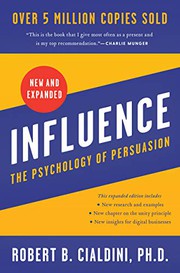
The foundational and wildly popular go-to resource for the science of influence and persuasion—a renowned international bestseller, with over 5 million copies sold—now revised adding: new research, new insights, new examples, and online applications.
In the new edition of this highly acclaimed bestseller, Robert Cialdini—New York Times bestselling author of Pre-Suasion and the seminal expert in the fields of influence and persuasion—explains the psychology of why people say yes and how to apply these insights on human behavior ethically in business and everyday settings. Using memorable stories and relatable examples, Cialdini makes this crucial aspect of behavioral science surprisingly easy to understand. With Cialdini as a guide, you don’t have to be a scientist to learn how to use this science in your own decision-making.
You’ll learn Cialdini’s Universal Principles of Influence, including new research and new uses so you can become an even more skilled persuader—and just as importantly, you’ll learn how to defend yourself against unethical influence attempts. You may think you know these principles of social psychology, but without understanding their intricacies, you may be ceding their power to someone else.
Cialdini’s Principles of Persuasion:
- Reciprocation
- Commitment and Consistency
- Social Proof
- Liking
- Authority
- Scarcity
- Unity, the newest principle for this edition
Understanding and applying the principles ethically is cost-free and deceptively easy. Backed by Dr. Cialdini’s 35 years of evidence-based, peer-reviewed scientific research—including a three-year field study on what leads people to change—Influence, New and Expanded EPB is a comprehensive guide to using these principles to move others in your direction.
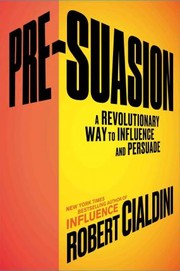
What separates effective communicators from truly successful persuaders? With the same rigorous scientific research and accessibility that made his Influence an iconic bestseller, Robert Cialdini explains how to prepare people to be receptive to a message before they experience it. Optimal persuasion is achieved only through optimal pre-suasion. In other words, to change “minds” a pre-suader must also change “states of mind.”
Named a “Best Business Books of 2016” by the Financial Times, and “compelling” by The Wall Street Journal, Cialdini’s Pre-Suasion draws on his extensive experience as the most cited social psychologist of our time and explains the techniques a person should implement to become a master persuader. Altering a listener’s attitudes, beliefs, or experiences isn’t necessary, says Cialdini—all that’s required is for a communicator to redirect the audience’s focus of attention before a relevant action.
From studies on advertising imagery to treating opiate addiction, from the annual letters of Berkshire Hathaway to the annals of history, Cialdini outlines the specific techniques you can use on online marketing campaigns and even effective wartime propaganda. He illustrates how the artful diversion of attention leads to successful pre-suasion and gets your targeted audience primed and ready to say, “Yes.” His book is “an essential tool for anyone serious about science based business strategies…and is destined to be an instant classic. It belongs on the shelf of anyone in business, from the CEO to the newest salesperson” (Forbes).
He says that's his best offer. Is it?
She says she agrees. Does she?
The interview went great—or did it?
He said he'd never do it again. But he did.
Read this book and send your nonverbal intelligence soaring. Joe Navarro, a former FBI counterintelligence officer and a recognized expert on nonverbal behavior, explains how to "speed-read" people: decode sentiments and behaviors, avoid hidden pitfalls, and look for deceptive behaviors. You'll also learn how your body language can influence what your boss, family, friends, and strangers think of you. You will discover:
- The ancient survival instincts that drive body language
- Why the face is the least likely place to gauge a person's true feelings
- What thumbs, feet, and eyelids reveal about moods and motives
- The most powerful behaviors that reveal our confidence and true sentiments
- Simple nonverbals that instantly establish trust
- Simple nonverbals that instantly communicate authority
Filled with examples from Navarro's professional experience, this definitive book offers a powerful new way to navigate your world.

A groundbreaking approach to creating memorable messages that are easy to process, hard to forget, and impossible to ignore—using the latest in brain science
Audiences forget up to 90 percent of what you communicate. But people make decisions and act based on what they remember, so a pragmatic approach for the effective communicator is to be deliberate about the 10 percent that audiences do retain. Otherwise, content recall is random and inconsistent.
Many experts have offered techniques on how to improve your own memory, but not how to influence other people’s memory. Drawing on the latest research in neuroscience and cognitive psychology, Impossible to Ignore is a practical step-by-step guide that will show you how to control the 10 percent that your audiences do remember by creating content that attracts attention, sharpens recall, and guides decision-making toward a desired action.

Often the decision between a customer choosing you over someone like you is your ability to know exactly what to say, when to say it, and how to make it count. Phil M. Jones has trained more than two million people across five continents and over fifty countries in the lost art of spoken communication. In Exactly What to Say, he delivers the tactics you need to get more of what you want.
Best-selling author and multiple award-winner Phil M. Jones is highly regarded as one of the world's leading sales trainers. He has trained more than two million people across five continents and fifty-six countries and coached some of the biggest global brands in the lost art of spoken communication. In 2013 he won the British Excellence in Sales and Marketing Award for Sales Trainer of the Year, the youngest-ever recipient of that honor. He has also written a series of best-selling books and developed a number of online training courses that have enrolled tens of thousands of members around the world. Phil divides his time between London and New York.
Praise for Exactly What to Say:
"Abracadabra--you are a millionaire! That is what will happen if you follow the advice from Phil Jones in this book."
--Jeffrey Hayzlett, primetime TV and podcast host, chairman of C-Suite Network
"Indeed, the right words spoken the right way, while perhaps not actually magic, can sure have the results of such."
--Bob Burg, co-author of The Go-Giver
"I think Phil says it best himself at the end of this fabulous read: "Everything you have learned in this book is simple, easy to do and works." It's tried and tested, proven and guaranteed to help you get your own way more often."
--Philip Hesketh, professional speaker and author on the psychology of persuasion and influence
"If you want to get prospects, clients, colleagues, bosses or anybody to say "yes" to what you want, I have three magic words of advice for you: "Get this book!"
--Sylvie di Giusto, keynote speaker and corporate image consultant
"This book is packed with ideas and easy-to-implement suggestions that will assist any individual in obtaining the outcomes they require from the conversations they have."
--Grant Leboff, CEO, StickyMarketing.com
"Exactly What to Say is packed full of real-world solutions that will lead you to achieving the outcomes you desire in life and business."
--Richard Dixon, director, Holidaysplease
"If you want to sell more and influence better, then this book is as close as you'll get to a magic wand or silver bullet to success!"
--Rob Brown, founder Networking Coaching Academy and bestselling author of Build Your Reputation
"Phil Jones helps uncover the truth in complex selling situations. These powerful phrases demonstrate how to influence others with integrity while never seeming pushy. You'll use these gems each and every day."
--Ian Altman, co-author of Same Side Selling, Forbes.com columnist
"Exactly What to Say could replace just about every other book on human behavior--it's that useful."
--John Jantsch, author of Duct Tape Marketing
"In this short but powerpacked book, [Jones] shares how to use certain key phrases to help you with the winning edge."
--Bryan Eisenberg, NYT bestselling author of Waiting for Your Cat to Bark? and Be Like Amazon
"Exactly What to Say is a must-read for anyone looking to be more persuasive in their business and personal lives."
--Seth Price, bestselling author of The Road to Recognition
Negotiation
Negotiation
This international bestseller, with more than 5 million copies sold, offers a field-tested approach to high-stakes negotiations and conflict resolution—whether in the boardroom, in your community, or at home.
Life is a series of negotiations, and negotiation is at the heart of collaboration—whether you are a business executive, a salesperson, a parent , a community leader, or a spouse. As a former FBI hostage negotiator, Chris Voss gives you the negotiation skills to be effective in any situation: negotiating a business deal, buying (or selling) a car, negotiating a salary, acquiring a home, renegotiating rent, deliberating with your partner, or communicating with your children. Taking the power of persuasion, tactical empathy, active listening, and intuition to the next level, Never Split the Difference gives you the competitive edge in any difficult conversation or challenging situation. This book is a masterclass in influencing others, no matter the circumstances.
After a stint policing the rough streets of Kansas City, Chris Voss joined the FBI, where his career as a hostage negotiator brought him face-to-face with a range of criminals, including bank robbers and terrorists. Reaching the pinnacle of his profession, he became the FBI’s lead international kidnapping negotiator. Never Split the Difference distills the Voss method, revealing the skills that matter most when it comes to achieving your goals in both your professional and personal life.
Step-by-step, Voss show you how to:
- Establish Rapport
- Create Trust with Tactical Empathy
- Gain the Permission to Persuade
- Shape What Is Fair
- Calibrate Questions
- Transform Conflict into Collaboration
- Spot Liars
- Create Breakthroughs by Revealing the Unknown Unknowns
Never Split the Difference is your definitive source for effective business communication, defusing potential crises, winning people over, and achieving your goals at work and at home.
How can you negotiate successfully with a stubborn boss, an irate customer, or a deceitful coworker?
In Getting Past No, William Ury of Harvard Law School's Program on Negotiation offers a proven breakthrough strategy for turning adversaries into negotiating partners. You'll learn how to:
- Stay in control under pressure
- Defuse anger and hostility
- Find out what the other side really wants
- Counter dirty tricks
- Use power to bring the other side back to the table
- Reach agreements that satisfies both sides' needs
Getting Past No is the state-of-the-art book on negotiation for the twenty-first century. It will help you deal with tough times, tough people, and tough negotiations. You don't have to get mad or get even. Instead, you can get what you want!
"From the Trade Paperback edition."
“The authors have packed a lot of commonsensical observation and advice into a concise, clearly written little book.”—Bloomberg Businessweek
One of the key business texts of the modern era, Getting to Yes has helped millions of people learn a better way to negotiate. Based on the work of the Harvard Negotiation Project, a group that deals with all levels of negotiation and conflict resolution, it offers readers a straightforward, universally applicable method for reaching mutually satisfying agreements—at home, in business, and with people in any situation. Read Getting to Yes to learn, step-by-step, how to
• disentangle the people from the problem
• focus on interests, not positions
• work together to find creative and fair options
• negotiate successfully with anybody at any level
Erickson
Erickson
Milton H. Erickson has been called the most influential hypnotherapist of our time. Part of his therapy was his use of teaching tales, which through shock, surprise, or confusion—with genius use of questions, puns, and playful humor—helped people to see their situations in a new way. In this book Sidney Rosen has collected over one hundred of the tales. Presented verbatim and accompanied by Dr. Rosen's commentary, they are grouped under such headings as Motivating Tales, Reframing, and Capturing the Innocent Eye.


Virgina Satir
Virgina Satir
On Thinking
On Thinking
New York Times Book Review Paperback Row selection
“Engaging and entertaining . . . a glimpse of the economy of the future.” —Tim Wu, New York Times Book Review
From the New York Times bestselling author of The Signal and the Noise, the definitive guide to our era of risk—and the players raising the stakes
In a world wired for chaos, these players are rewriting the rules. High-stakes, high-IQ, and often high on their own mythologies, they are driving the next era of finance, tech, and politics. But what happens when their bets go too far?
Nate Silver’s On The Edge reveals the hidden world of the River. It is the domain of gamblers and like-minded folks who move markets and change the fabric of society: poker legends, hedge fund titans, crypto speculators, and even those willing to bet the world’s future on AI. They are obsessives with a deep hunger for volatility and an unrelenting desire to exploit every edge over the rest of us. Silver embeds with them, competing in the World Series of Poker, visiting Sam Bankman-Fried’s FTX compound, and attending wild Miami yacht parties at the height of the crypto bubble.
On the Edge is a front-row seat to a new world order built on risk, math, and ambition—a gripping ride through the minds shaping your future, whether you like it or not.

"This blazing-hot forbidden romance manages to sensibly, and compassionately, capture the complexities of starting adult life after college and finding love and your identity in middle age. Cassie and Erin’s romance is by turns delightfully raunchy and deeply emotional. This reader hopes Wilsner keeps these scorchers coming." - The Washington Post
“[Wilsner writes] erotic yearning in a class all their own.” - Entertainment Weekly
From Meryl Wilsner, the acclaimed author of Something to Talk About, comes Mistakes Were Made, a sharp and sexy rom-com about a college senior who accidentally hooks up with her best friend’s mom.
When Cassie Klein goes to an off-campus bar to escape her school’s Family Weekend, she isn’t looking for a hookup—it just happens. Buying a drink for a stranger turns into what should be an uncomplicated, amazing one-night stand. But then the next morning rolls around and her friend drags her along to meet her mom—the hot, older woman Cassie slept with.
Erin Bennett came to Family Weekend to get closer to her daughter, not have a one-night stand with a college senior. In her defense, she hadn’t known Cassie was a student when they'd met. To make things worse, Erin’s daughter brings Cassie to breakfast the next morning. And despite Erin's better judgement—how could sleeping with your daughter’s friend be anything but bad?—she and Cassie get along in the day just as well as they did last night.
What should have been a one-time fling quickly proves impossible to ignore, and soon Cassie and Erin are sneaking around. Worst of all, they start to realize they have something real. But is being honest about the love between them worth the cost?
"Wilsner proves their serious romance range with a sophomore novel that laughs in the slow-burning face of their debut by kicking off with a hookup that'll have you fanning your face for days." - Buzzfeed
“A steaming hot, thoughtful story about all kinds of love, featuring a firecracker of a couple that’s impossible not to root for.” - Women's Health
Whether we're buying a pair of jeans, ordering a cup of coffee, selecting a long-distance carrier, applying to college, choosing a doctor, or setting up a 401(k), everyday decisions -- both big and small -- have become increasingly complex due to the overwhelming abundance of choice with which we are presented.
As Americans, we assume that more choice means better options and greater satisfaction. But beware of excessive choice: choice overload can make you question the decisions you make before you even make them, it can set you up for unrealistically high expectations, and it can make you blame yourself for any and all failures. In the long run, this can lead to decision-making paralysis, anxiety, and perpetual stress. And, in a culture that tells us that there is no excuse for falling short of perfection when your options are limitless, too much choice can lead to clinical depression.
In The Paradox of Choice, Barry Schwartz explains at what point choice -- the hallmark of individual freedom and self-determination that we so cherish -- becomes detrimental to our psychological and emotional well-being. In accessible, engaging, and anecdotal prose, Schwartz shows how the dramatic explosion in choice -- from the mundane to the profound challenges of balancing career, family, and individual needs -- has paradoxically become a problem instead of a solution. Schwartz also shows how our obsession with choice encourages us to seek that which makes us feel worse.
By synthesizing current research in the social sciences, Schwartz makes the counter intuitive case that eliminating choices can greatly reduce the stress, anxiety, and busyness of our lives. He offers eleven practical steps on how to limit choices to a manageable number, have the discipline to focus on those that are important and ignore the rest, and ultimately derive greater satisfaction from the choices you have to make.
A better way to combat knee-jerk biases and make smarter decisions, from Julia Galef, the acclaimed expert on rational decision-making.
When it comes to what we believe, humans see what they want to see. In other words, we have what Julia Galef calls a "soldier" mindset. From tribalism and wishful thinking, to rationalizing in our personal lives and everything in between, we are driven to defend the ideas we most want to believe—and shoot down those we don't.
But if we want to get things right more often, argues Galef, we should train ourselves to have a "scout" mindset. Unlike the soldier, a scout's goal isn't to defend one side over the other. It's to go out, survey the territory, and come back with as accurate a map as possible. Regardless of what they hope to be the case, above all, the scout wants to know what's actually true.
In The Scout Mindset, Galef shows that what makes scouts better at getting things right isn't that they're smarter or more knowledgeable than everyone else. It's a handful of emotional skills, habits, and ways of looking at the world—which anyone can learn. With fascinating examples ranging from how to survive being stranded in the middle of the ocean, to how Jeff Bezos avoids overconfidence, to how superforecasters outperform CIA operatives, to Reddit threads and modern partisan politics, Galef explores why our brains deceive us and what we can do to change the way we think.
“THIS. This is the right book for right now. Yes, learning requires focus. But, unlearning and relearning requires much more—it requires choosing courage over comfort. In Think Again, Adam Grant weaves together research and storytelling to help us build the intellectual and emotional muscle we need to stay curious enough about the world to actually change it. I’ve never felt so hopeful about what I don’t know.”
—Brené Brown, Ph.D., #1 New York Times bestselling author of Dare to Lead
The #1 New York Times bestselling author of Hidden Potential, Originals, and Give and Take examines the critical art of rethinking: learning to question your opinions and open other people's minds, which can position you for excellence at work and wisdom in life
Intelligence is usually seen as the ability to think and learn, but in a rapidly changing world, there's another set of cognitive skills that might matter more: the ability to rethink and unlearn. In our daily lives, too many of us favor the comfort of conviction over the discomfort of doubt. We listen to opinions that make us feel good, instead of ideas that make us think hard. We see disagreement as a threat to our egos, rather than an opportunity to learn. We surround ourselves with people who agree with our conclusions, when we should be gravitating toward those who challenge our thought process. The result is that our beliefs get brittle long before our bones. We think too much like preachers defending our sacred beliefs, prosecutors proving the other side wrong, and politicians campaigning for approval--and too little like scientists searching for truth. Intelligence is no cure, and it can even be a curse: being good at thinking can make us worse at rethinking. The brighter we are, the blinder to our own limitations we can become.
Organizational psychologist Adam Grant is an expert on opening other people's minds--and our own. As Wharton's top-rated professor and the bestselling author of Originals and Give and Take, he makes it one of his guiding principles to argue like he's right but listen like he's wrong. With bold ideas and rigorous evidence, he investigates how we can embrace the joy of being wrong, bring nuance to charged conversations, and build schools, workplaces, and communities of lifelong learners. You'll learn how an international debate champion wins arguments, a Black musician persuades white supremacists to abandon hate, a vaccine whisperer convinces concerned parents to immunize their children, and Adam has coaxed Yankees fans to root for the Red Sox. Think Again reveals that we don't have to believe everything we think or internalize everything we feel. It's an invitation to let go of views that are no longer serving us well and prize mental flexibility over foolish consistency. If knowledge is power, knowing what we don't know is wisdom.
The guru to the gurus at last shares his knowledge with the rest of us. Nobel laureate Daniel Kahneman's seminal studies in behavioral psychology, behavioral economics, and happiness studies have influenced numerous other authors, including Steven Pinker and Malcolm Gladwell. In Thinking, Fast and Slow, Kahneman at last offers his own, first book for the general public. It is a lucid and enlightening summary of his life's work. It will change the way you think about thinking.
Two systems drive the way we think and make choices, Kahneman explains: System One is fast, intuitive, and emotional; System Two is slower, more deliberative, and more logical. Examining how both systems function within the mind, Kahneman exposes the extraordinary capabilities as well as the biases of fast thinking and the pervasive influence of intuitive impressions on our thoughts and our choices. Engaging the reader in a lively conversation about how we think, he shows where we can trust our intuitions and how we can tap into the benefits of slow thinking, contrasting the two-system view of the mind with the standard model of the rational economic agent.
Kahneman's singularly influential work has transformed cognitive psychology and launched the new fields of behavioral economics and happiness studies. In this path-breaking book, Kahneman shows how the mind works, and offers practical and enlightening insights into how choices are made in both our business and personal lives--and how we can guard against the mental glitches that often get us into trouble.